|
VALLECITOS
& ACONCAGUA EXPEDITION
January
30,2016 to February 17, 2016
Polish
Traverse

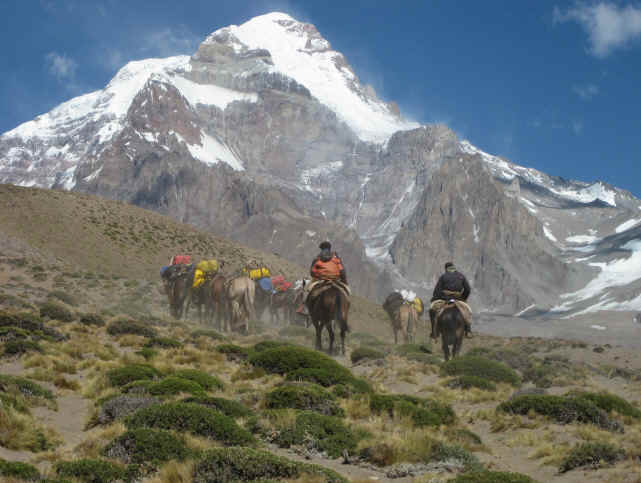
This is fast becoming a popular Aconcagua option, with the highest
success rate. We spend the first week acclimatizing in the Silver Range, a part
of the large frontal range, between main Andes and the Pre Andes. This
pre-acclimatization approach is increasing summit success ten fold and also
offers participants a little more of Argentina instead just going straight to
the mountain and home again.
- DATE
- Jan. 30 to Feb.
17, 2016 & 2017
- COST:
$4300.00US
(based on a minimum of 4 participants maximum 7)
- LOCATION:
Aconcagua is located in Northern Argentina, in the Province of
Mendoza, where the summit is just 12 kilometers from the Chilean border
- ROUTE: Polish
Traverse
-
We
climb a pyramid shaped peak called Vallecitos (5400m/17,440 ft), in
order to acclimatize more effectively and explore a beautiful mountain
area instead of going up and down multiple times on the same route on
Aconcagua carrying loads to acclimatize. This acclimatization side
trip is followed by a rest day in Penitentes. This allows us to tackle
Aconcagua with renewed energy and motivation and in great physical
condition, allowing us to do the climb in only one day. Our climbing
route on Aconcagua is the Standard Route.
-
- PHOTO
GALLERY
-
- BLOGS
| DATE |
NIGHT |
ITINERARY
|
| Jan 30 |
Hotel |
Arrive
Mendoza- transfer to our hotel. This is a lovely little city and
wine capital of Argentina. |
| Jan 31 |
Lodge |
Final
day for permit issuance, last minute supplies shop and board mini
van for Vallectios Ski Resort at (3000m-9900 ft.) located in the
Silver Range, part of the large frontal range. We will stay in a
lodge. Dinner and breakfast included. |
| Feb 01 |
Camp |
Up
early, 3- hour hike to Peidra Grande (3500m) “ the big boulder”-
Mules will pack our bags, tents and food supplies |
| Feb 02 |
Camp |
5-
hour hike to Salto De Agua campsite- (4100m) “little water fall” |
| Feb
03 |
Camp |
Rest
day , to help with acclimatization. |
| Feb 04 |
High
Camp |
2-
hour hike to La Hollada- (4900m) “big hole” |
| Feb 05 |
Camping |
8-
hours to the SUMMIT of Vallecitos Peak- (5400m-17,800 ft). With an
early start we climb up the slopes to gain an obvious saddle. From
here, we follow an easy yet majestic ridge to the summit. Full day
climb with great vistas of the nearby peaks including Aconcagua.
Return to La Hollada camp. |
| Feb 06 |
Lodge |
4-hours,
back to Vallecitos Ski Resort |
| Feb 07 |
Hotel |
After
a late morning start and breaking down camp, we return to Vallecitos
Ski Resort where our mini van will be waiting to take us to
Penitentes. spend the night, dinner and breakfast. |
| Feb 08 |
Camp |
Transfer
by van to park gate. Hike to Confluencia (3300m) camp, mules carry
equipment, bags and food. |
| Feb 09 |
Camp |
Hike
to Plaza De Mulas 4370m – 8-hours- supported by mules. |
| Feb 10 |
Camp |
Plaza
De Mulas- 4370m- acclimatization layover. |
| Feb 11 |
Camp |
Cambio
Pendigente- 5100m 5-hours or Nido De Condores 5530m 6.5 hours |
| Feb 12 |
Camp |
Chorela-
6000m- 3 to 4 hours. |
| Feb
13 |
Camp |
SUMMIT
DAY – 6962m- 15- hours round trip, camp at Chorela. |
| Feb 14 |
Camp |
Plaza
De Mulas |
| Feb 15 |
Hotel |
Pente
del Inca (trail head) 8- hours plus 3 hour drive to Mendoza. |
| Feb 16 |
|
Contingency
Day |
| Feb 17 |
|
Contingency
Day |
| Feb 18 |
|
transfer to
the airport or take in other parts of Argentina: Buenos Aires,
Patagonia etc. all within reach. |
EVEREST
ALTITUDE TRAINING- This past year successful Everest
summits by various climbers including two Peak Freak members, made a trip to
Aconcagua pre-Everest. This is a non-technical peak offering excellent altitude
prior to an Everest bid. Acclimatization can stay with you up to three
weeks or more making this trip an excellent pre-Everest preparation climb. We
book up fast so if you miss this one you can also explore the idea of joining
our Pumori Everest Training climb in the Himalayas:
Everest Training Climb -Nepal
Day 1- Jan. 30:
Our expedition begins in Mendoza, Argentina.
Upon your arrival to the international airport or bus station in the City of
Mendoza transfer to the hotel to hitch up with Tim or Angel to go over your gear
items. This is a very
important step. Mendoza is the last place available, where you can buy or rent
equipment, it is not always easy to find the things you need at the last
minute in this city so please do your best to get properly geared up before
arriving here. After this, there is a group meeting and later we will go out to one of the
many fine restaurants for dinner. You get the chance to taste the delicious
argentine "asado" (barbecued meat) and wonderful wines from Mendoza.
There are numerous alternatives for those who do not drink wine or eat red
meats. Dinner in Argentina is usually around 9:00 P.M.
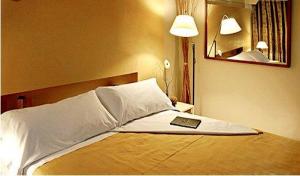
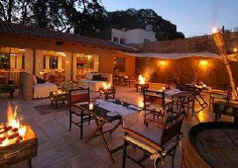
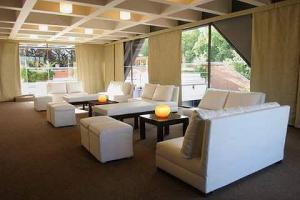
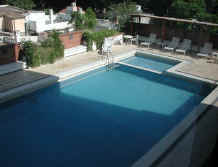
We use the well appointed Hotel Aconcagua
for our Mendoza base camp on our expeditions:
AIRPORT ARRIVAL
- Transport by taxi (cost $6US to $9US) to th Hotel
Aconcagua. After clearing customs proceed out the door and taxi's will be
waiting to whisk you away.
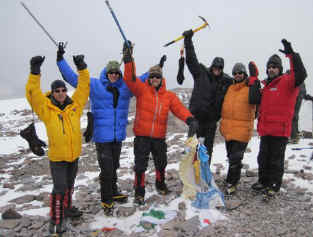
- Transport to and from Mendoza-Penitentes in a private
vehicle. From the hotel we take you to Penitentes, 180km, over a mountainous
road where you can enjoy the most spectacular view of the Central Andes.
Overnight at the Aylen Hotel.
- Transport to and from Penitentes to the entrance of
Aconcagua Park to start the trekking.
PERMIT
- We no longer include this amount in the above program
costs. We are advised since the amount changes frequently so it is better that each participant pay upon arrival the rate at that time.
You can estimate to bring with you between $300 to $400US for this.
LODGING
- Hotel Aconcagua in Mendoza is at your expense.
We have secured rates between $75 and $85US per night. You should budget for
2-nights here. One inbound and one outbound but adding an extra one inbound is a
good idea should bags go astray.
- We include one (1) night at the Aylen Hotel
in Penitentes, a 3***, Double or triple, half board, beverages not included.
For the past years, this ski center, Penitentes, has been the starting point
for most expeditions to the Aconcagua. Some expeditions go through Puente
del Inca, but we prefer Penitentes because the lodging is better. In
Penitentes, you can find from hostels to 3*** hotels. Peak Freaks works with
the Aylen Hotel *** Star, which offers single, double and triple rooms with
private bathrooms. The welcome dinner, breakfast and taxes are included.
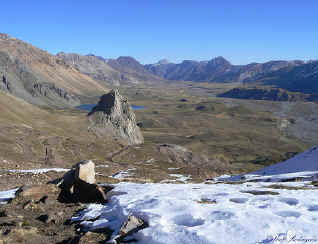
- We include (2) nights at a basic lodge at the Vallecitos
Ski Resort.
MEALS
- All meals are included during the approach tot Base Camp and high altitude camps. Complete and balanced diet. Meals are
prepared daily by the cooks at the camps. And then expedition
simplified meals are organized for the higher camps.
COMMUNICATIONS
- There is permanent communication, 24 hours a
day, through VHF, HF radios, Satellite Telephones, between Base Camps,
mountain expeditions, Penitentes and Mendoza. This is for safety and
organization that will lead your expedition to be a successful one.
MULES
- Mules for equipment transportation (30
kg/person) up the Valle de Vacas (Vacas Valley) is included. "Responsibility and
Confidence
service" means taking your equipment on time and in perfect conditions
to and from Base Camp and back to Penitentes. Each person has
the right to transport up to 30 kg. We recommend you take a resistant bag,
even though the gear is protected for transportation.
PORTERS
- We now employ two porters to 7 clients to help with
loads on Aconcagua.
FOOD
- The kitchen and food tents are completely
equipped with tables, chairs, dishes. Our base camp tents is an exclusively designed
dome, made to provide the highest comfort and
quality services.
MEDICAL
- Our Base Camps have hyperbaric
chambers, oxygen equipment, oximeters and first aid kits for an immediate
response under any situation. You will be seen by a medical examiner at base
camp to determine your state of health for the climb.
TENTS
- Peak Freak provides our own sleeping tents and we
contribute financially to the use of the latrines established at the camps. We provide
our clients with the best mountain tents available.
- Our Aconcagua base camp has a hyperbaric
chamber, oxygen equipment, oximeters and first aid kits for an immediate
response under any situation. You will be seen by a medical examiner at base
camp to determine your state of health for the climb.
EQUIPMENT LIST FOR MEN AND WOMEN:
Climbing Gear
__ Ice axe w/leash Light weight (i.e. Grivel Air tech or Black Diamond Raven)
under 5’7” use 60cm, 5’7”- 6’2” use 65cm, over 6’2” use 70cm
__ 1 pair plastic expedition boots Make sure that the boot is expedition quality
and has a new or in excellent condition stock liner or alveolite liner. Scarpa
Inferno or similar are recommended.
__ 1 pair insulated super-gaiters Super-gaiters will provide more warmth and are
required. If the toe section of the rubber rand of the gaiter fits loosely you
may want to consider gluing the toe section to the boot.
__ Crampons Must be fit to plastic boots prior to trip, new-matic type
recommended, (i.e. Grivel G12, Black Diamond Contact, or Charlet Moser Super 12
make sure they fit properly with your super-gaiters prior to arrival in
Argentina
__ Adjustable trekking poles
Upper Body
__ 2 cotton t-shirts
__ 1 polypropylene t-shirt
__ 2 long sleeve polypropylene shirt Lightweight, light coloured for sunny days.
__ 2 women sports bras Synthetic, no cotton!
__ 2 soft shells Marmot Dri-Clime Wind Shirt, Patagonia Stretch Zephur or
Krushell Jacket (R2 pullover acceptable).
__ Down/synthetic sweater or vest Patagonia Puffball Jacket or Sweater
preferred, R4/ 300 weight fleece jacket acceptable.
__ Hard shell jacket with hood Waterproof and breathable. Gore-Tex or equivalent
is best, roomy enough to fit over multiple layers.
__ 1 expedition down parka with hood. This is probably your most important piece
of clothing! It is important that your jacket is 700+ fill down, baffle
construction (not sewn through seams) and has a thick insulated hood.
Hand wear
We require two systems; one glove system for lower on the mountain and a
mitten over-mitt system for the cold temperatures encountered on summit day.
__ 2 pair liner gloves Thin wool or polypropylene
__ 1 pair warm glove Fleece or wool
__ 1 pair expedition shell gloves
__ 1 pair modular expedition shell mitts. OR Pro Mitts If they do not have wrist
straps consider sewing one on so that you can either attach it to your jacket or
cinch the strap to your wrist so that you do not loose your mittens in high
winds.
Head gear
__ Warm hat Wool or synthetic that cover your ears.
__ Balaclava
__ Face mask
__ Shade hat or baseball cap
__ Glacier glasses 100% UV protection with side shields and a hard-sided storage
case (i.e. Julbo or Cebe)*
__ 1 pair extra sunglasses (Also with UV protection in case your primary pair
breaks)
__ 1 ski goggles With UV protection *
Lower Body
__ 3 pair liner socks
__ 3 pair light weight trekking socks
__ 3 pair med-heavy wool socks Check boot fit with liner and wool socks on
__ 1 pair nylon shorts
__ 1 pair nylon pants For trekking and around camp
__ 2 pair lightweight long underwear bottoms
__ 1 pair fleece pants w/ side zipper or farmer johns or “puff-ball pants”
__ 1 pair soft shell pants. (i.e., Patagonia Guide pants or OR Granite Pants.
Schoeller fabrics)
__ 1 pair of hard shell pants. Waterproof/ breathable with full side zips,
Gore-Tex or equivalent is best.
__ 1 pair down booties (optional)
__ 1 pair trail shoes for the hike to base camp and use at camp.
__ 1 pair sandals or tennis shoes for river crossings and in camp.
All clothing should be kept dry using waterproof stuff sacks or large plastic
bags
Sleeping gear
__ 1 down or synthetic sleeping bag Rated to at least -10F
__ Sleeping pad full length closed cell foam (mandatory) and a Therma-Rest
for extra warmth and comfort
Back Packs
__ 1 large capacity internal frame pack Approx. 5000+ cubic inches
__ 1 daypack for the approach hike, possible use on summit day and carry-on
pack. If you plan to use it for your summit pack it must be large enough for
your down jacket, misc. clothes, food and water. The Lowe Alpine Neutrino or
Black Diamond Speed 28 are excellent, lightweight (16 oz.) choices.
__ 2 large (7,500+cu.in.) duffle bags for gear must be durable for use on pack
animals
__ 1 small duffel bag To store in Mendoza
__ Small padlocks For duffel bags
Misc.
__ 1 first-aid kit With ibuprofen and any other doctor recommended
medications including a full dose of Ciproflaxin and some Diamox.
__ Lip balm At least SPF 20, 2 sticks. A string taped to the stick is helpful,
to hang around your neck
__ Sunscreen At least SPF 40
__ Headlamp
__ 3 Water bottles 1 liter wide-mouth Nalgene (1 is a pee bottle).
__ Hydration bladder With drinking tube for lower mountain-(optional).
__ 2 water bottle insulators
__ Plastic mug With snap-on lid, 16 oz. or larger.
__ Bowl and spoon Plastic, small Tupperware works well. Lexan spoons are best.
__ Pocket knife Small Swiss-Army type.
__ Water purification Iodine tablets or Polar-pure crystals.
__ Toiletry kit Be sure to include toilet paper stored in a plastic bag. Women:
Tampons and storage bag for disposal. Midol and other cramp meds. Iron
supplementing pre-expedition is also a very good idea for our female climbers to
help with acclimatization.
__ 3-4 large plastic bags for keeping miscellaneous gear dry
__ Nylon stuff sacks For food and gear storage (OR has a good selection); large
Ziplocs are useful also
__ Bandana
__ Camp towel
__ Ear plugs
__ Hand wipes
__ 1 small stainless steel thermos Optional
__ Favorite snack foods No more than 2 pounds!
__ Paperback books, cards, iPod etc.
__ Camera Optional, 1 light weight point & shoot on the mountain,
__ Fanny pack or wallet For travel documents, money & passport
__ Passport and passport photos- passport valid for not less than 6 months from
your arrival date.
__Airline ticket
BOOKING
Contact trek@peakfreaks.com
$1000 US deposit is due at time of booking. Final
amount is due: 90 days prior to departure.
GUIDE - Gaspar Navarrete
Gangotena
|